Introduction / Chapter 3
Island Forests
About one third of Tokyo's forests are on the Izu and Ogasawara islands. The islands hold about 26,000 hectares of forest, mostly natural.[1] Their forests have a completely different history from Tama, which is dominated by cedar and cypress plantations.
(14,755 / 19,172 ha)[1]
| Category | Tama | Islands |
|---|---|---|
| Private, planted | 30,708 | 3,274 |
| Private, natural | 20,318 | 14,755 |
| Private, unstocked etc. | 659 | 1,143 |
| National forest | 1,182 | 6,526 |
| Total | 52,867 | 25,698 |
Unit: ha. Source: Tokyo Metropolitan Government, Forest Development Promotion Plan, Table 1-1[1]. Shares calculated from the table.
Izu Islands: forests of chinquapin and machilus
The forests of Mikurajima are dominated by Castanopsis (sudajii) and Machilus (tabunoki). There are many giant trees, and the forest keeps a near-primeval character. Near the summit it gives way to windswept grassland.[2] The island is known for boxwood and mulberry as forest products.[3]
On Miyakejima you can see the order in which forest returns after an eruption: bare ground, volcanic grassland, scrub, mixed deciduous and evergreen woodland, and finally Castanopsis forest.[2] Niijima and Shikinejima have secondary forests of Castanopsis and Machilus, and coastal black pine forests.[2]
Ogasawara: forests still evolving
The Ogasawara Islands were inscribed as a World Natural Heritage site in 2011. About 70% of their tree species are endemic.[4] The inscription recognized that their endemic species are still in the process of evolving.[5]
Of the islands' total area of 10,688 ha, national forest covers 6,620 ha, about 62%. In 2007, 5,579 ha of it was designated a Forest Ecosystem Reserve.[5] Meanwhile invasive trees brought in by people, such as bishop wood (akagi) and Casuarina, are spreading, and removal continues.[5]
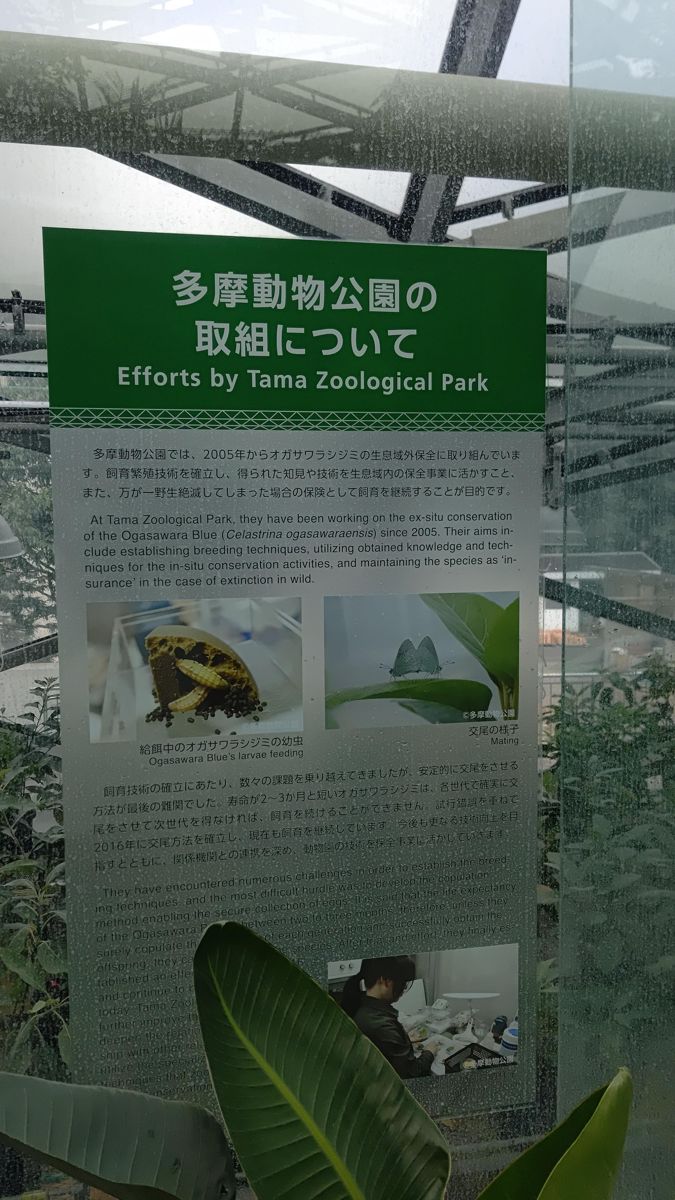
It is not only forests that are being lost, but also the creatures that depend on them. The Ogasawara Blue, a butterfly found only in the Ogasawara Islands, has not been confirmed in the wild since a 2018 survey. Tokyo's Tama Zoological Park began ex-situ conservation breeding in 2005, with some individuals also kept at Shinjuku Gyoen, but the last captive individual died on August 25, 2020.[6]
How invasive trees are removed
The Kanto Regional Forest Office uses different methods depending on the species.[7]
| Tree Species | Method | How |
|---|---|---|
| Casuarina etc. | Felling | Cut down large trees[7] |
| Bishop wood (akagi) | Girdling | Strip the bark and let the tree die standing[7] |
| White leadtree (ginnemu) | Pulling | Pull out by the roots[7] |
In FY2009, about 11 hectares of bishop wood were removed at Sekimon and Kuwanokiyama on Hahajima and elsewhere, and about 8 hectares of Casuarina and other trees on Anijima.[7] Local groups also take part in removal and patrols.[7] The sources do not say what is done with the removed wood.
Sources
- 東京都「森づくり推進プラン」表1-1(原典:令和2年版 東京の森林・林業) PDF
- 環境省 富士箱根伊豆国立公園 指定書等資料 PDF
- 東京都 東京宝島 御蔵島レポート PDF
- 環境省 小笠原諸島 世界自然遺産資料 PDF
- 林野庁関東森林管理局 広報資料(小笠原の国有林) PDF
- 東京都 報道発表資料「オガサワラシジミに関する主要なできごと・取組」(2020年8月27日) PDF
- 林野庁関東森林管理局 東京事務所「森林生態系の保全」 Link