Introducción / Capítulo 6
Elaboración y obras
Los troncos no se pueden usar tal cual. Hay que rajarlos, aserrarlos o laminarlos. Este capítulo sigue cómo se ha elaborado la madera desde el período Edo hasta hoy y cómo se ha usado en obras como postes y rellenos de tierra.
Trabajar la madera
Rajar: más antiguo que la sierra
El cedro crece recto y se raja fácilmente a lo largo de la fibra. Puede rajarse hasta unos 5 mm y se usaba para barriles y tinas.[1] Las sierras japonesas antiguas eran de corte transversal, poco aptas para cortar a lo largo.[2] Por eso se valoraba tanto la madera fácil de rajar.
Aserrar: el oga y el maebiki-oga
El oga, sierra para cortar la madera a lo largo, llegó de China en los siglos XIV–XV (mediados del período Muromachi). Su hoja, de unos 2 m de largo y 5 cm de ancho, se tensaba en un bastidor y la manejaban dos personas.[2] Permitió cortar tablas anchas y finas con facilidad, transformando la fabricación de tablas y la carpintería.[2]
A principios del período Edo apareció y se difundió el maebiki-oga, de una sola persona.[2] Los artesanos que aserraban troncos en tablas y vigas se llamaban kobiki, aserradores.
| Método | Época | Qué permite |
|---|---|---|
| Rajar | Desde antiguo | Rajar troncos rectos a lo largo; duelas para barriles y tinas[1] |
| Oga (dos personas) | Llega en los siglos XIV–XV | Cortar a lo largo tablas anchas y finas[2] |
| Maebiki-oga (una persona) | Se difunde a inicios de Edo | Un aserrador corta solo[2] |
| Laminada / CLT | Hoy | Piezas pequeñas encoladas en grandes pilares, vigas y muros[3] |
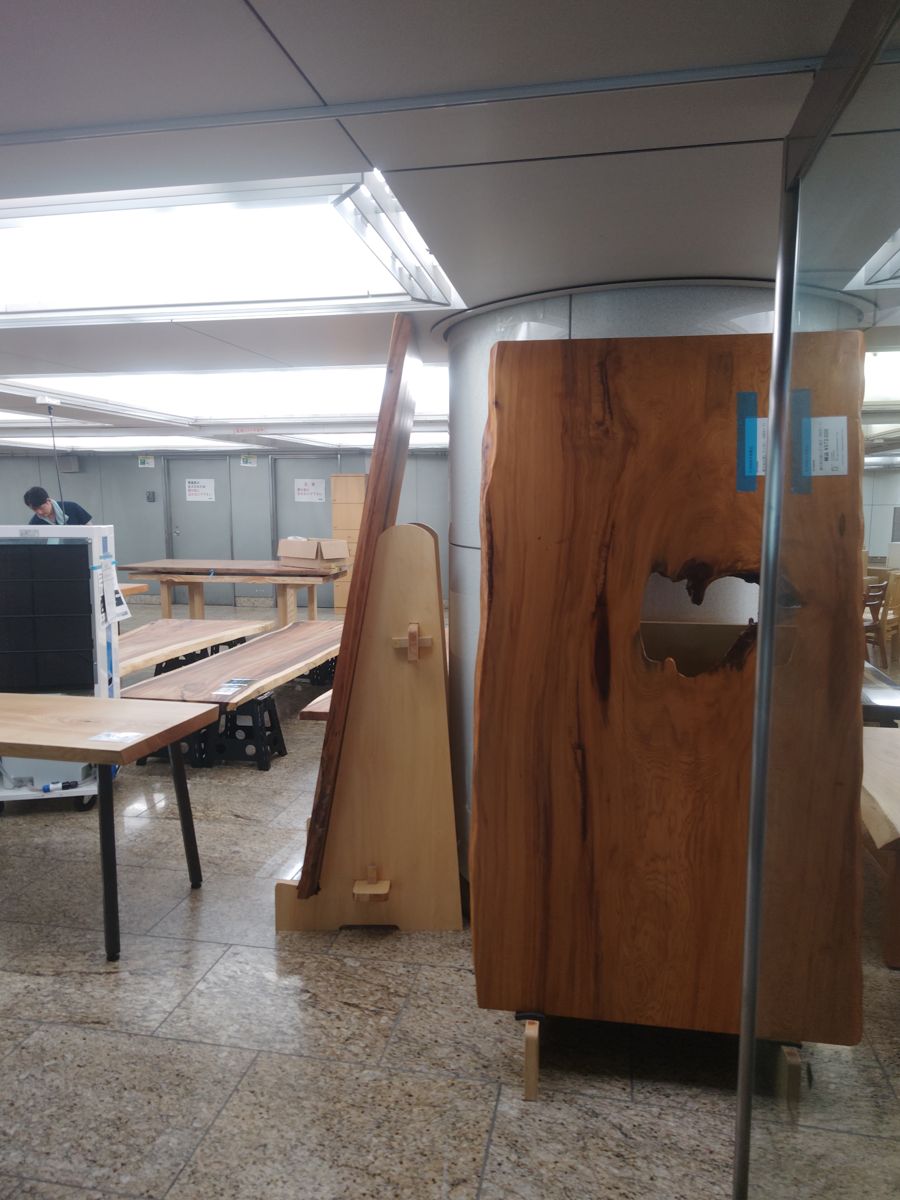
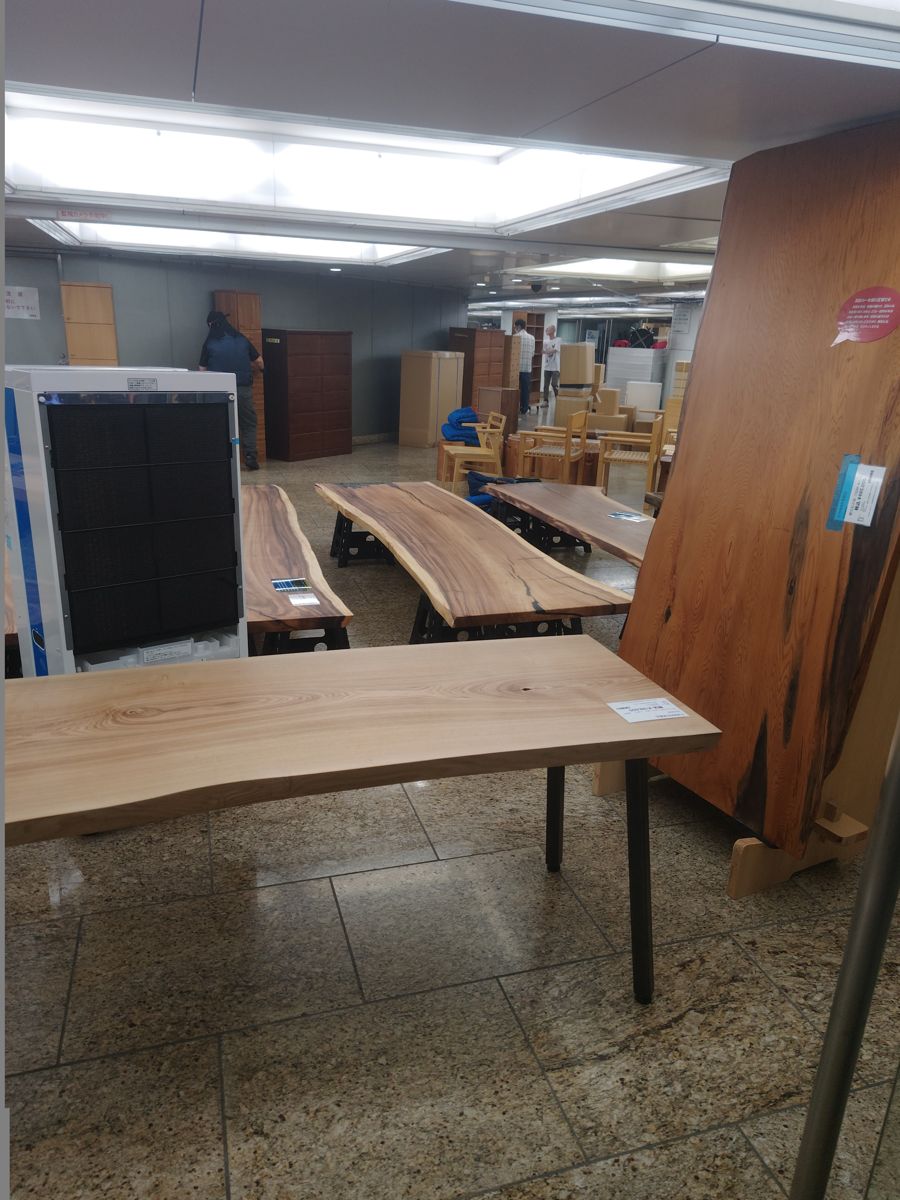
Single-piece slabs sawn from large trees remain popular. In July 2026, a slab sale was held in the event space beneath JR Shinjuku Station, with boards still bearing their bark-side edges (live edges) and boards with holes where knots had fallen out lined up as tabletops.
Laminar: madera laminada y CLT
Los edificios de madera actuales se sostienen con materiales laminados. La estructura de la cubierta del Estadio Nacional es de madera laminada de alerce y cedro, y las instalaciones de los atletas usan CLT nacional (paneles de tablas cruzadas).[3] En Nagano, una «viga apilada encolada» hecha con troncos de alerce de menos de 30 cm de diámetro ha obtenido certificación ministerial.[4] Poder convertir árboles delgados en piezas estructurales para grandes edificios es lo que hizo posibles los edificios de madera del centro de Tokio (capítulo 5).
Showing it off: furniture that makes use of cracks and rot
Cracks, rot holes and edges with bark left on are the parts usually cut away in ordinary sawmilling. Set in clear resin, they become furniture that shows those shapes as they are.
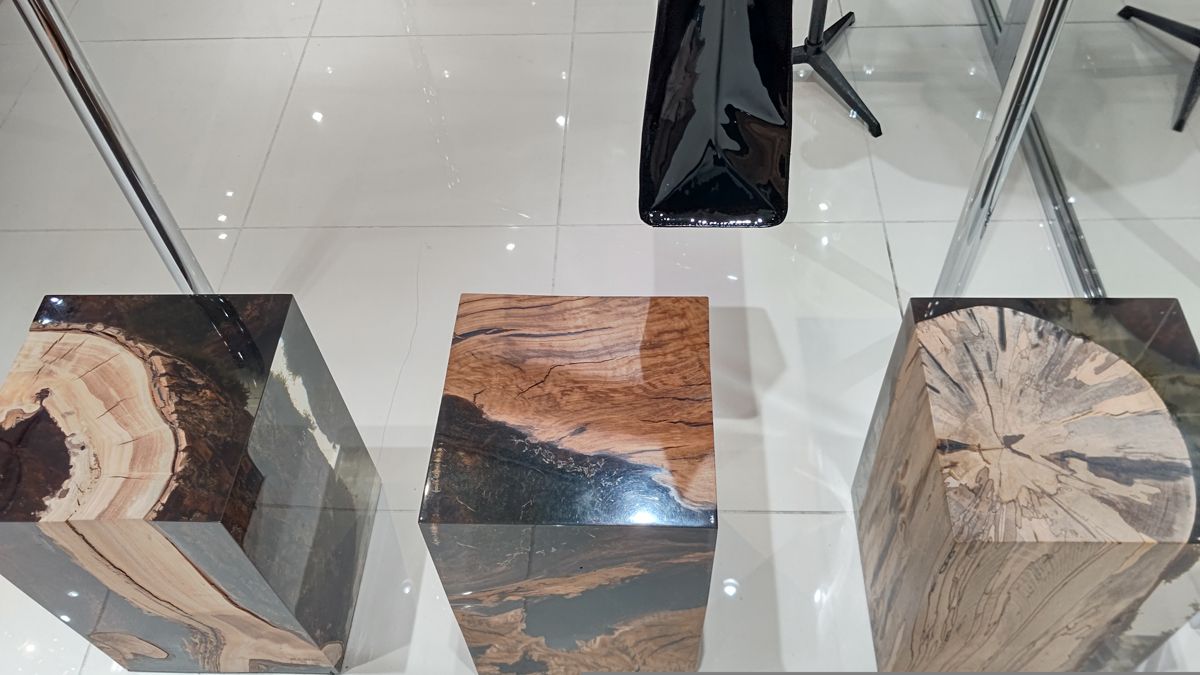
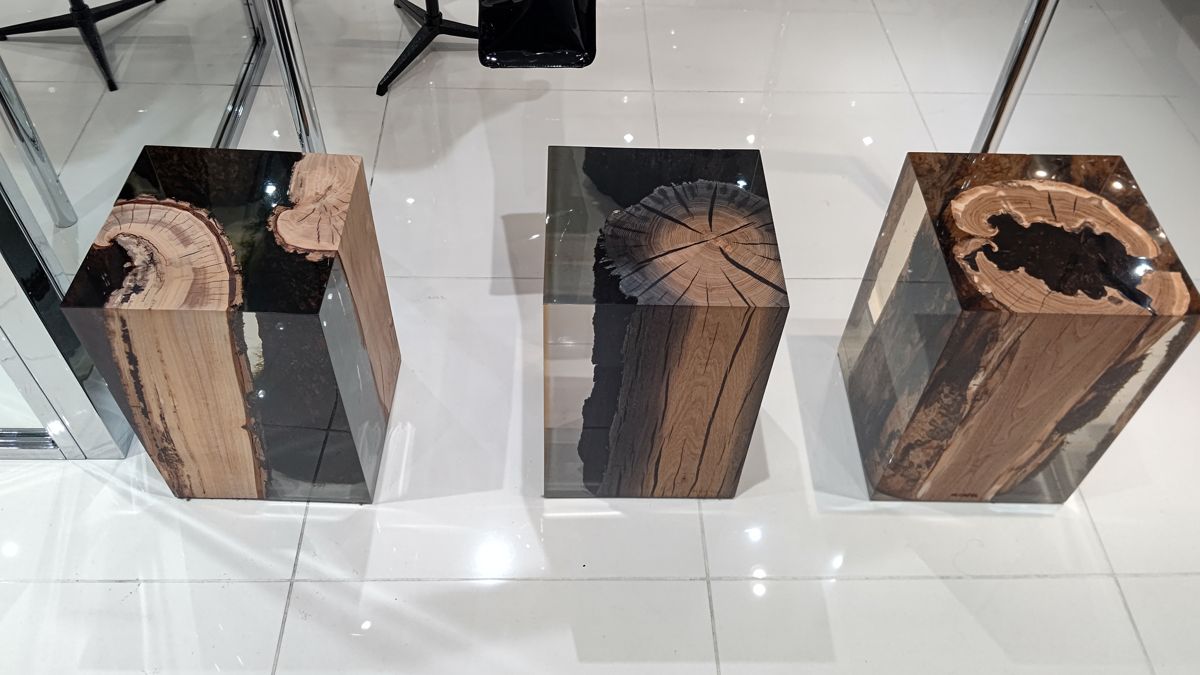
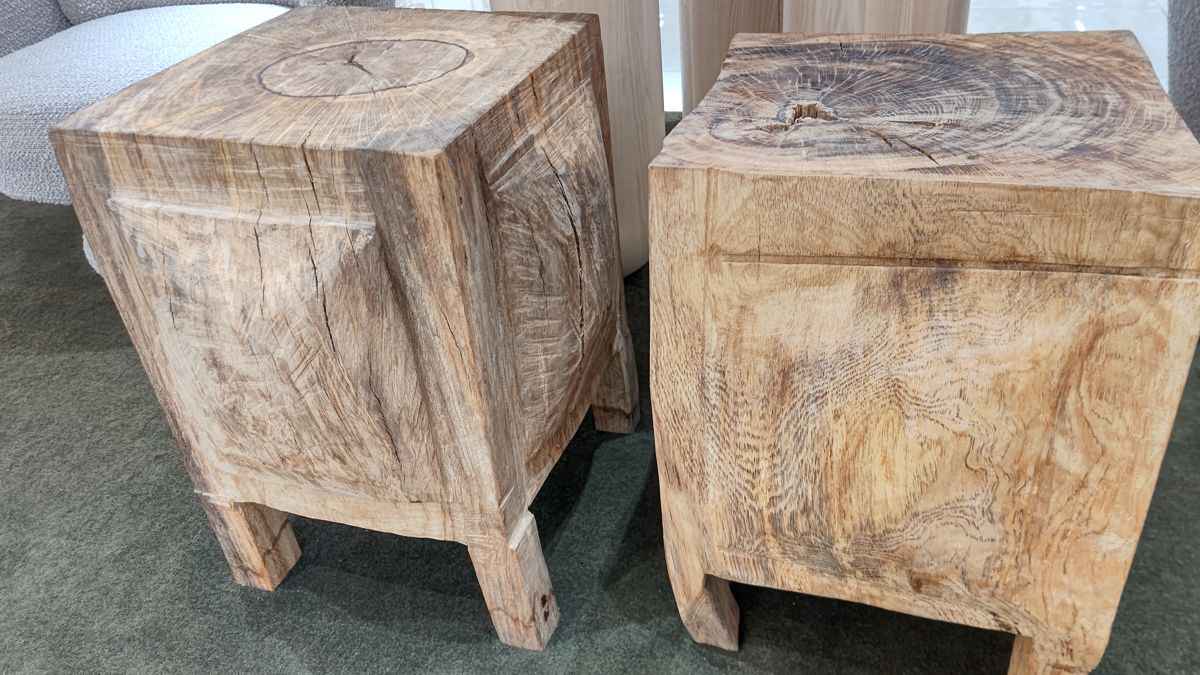
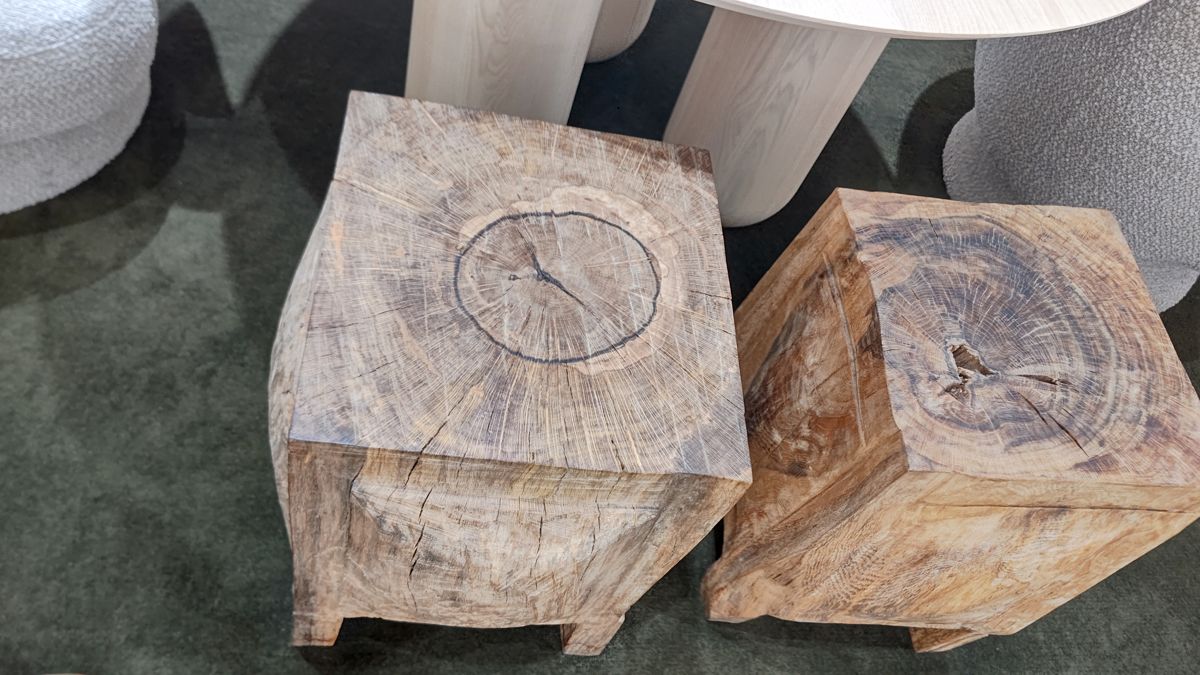
There were also solid-wood stools carved from blocks of log, without resin. The cracks running from the heart of the growth rings and the marks of the cutting tools are left as they are.
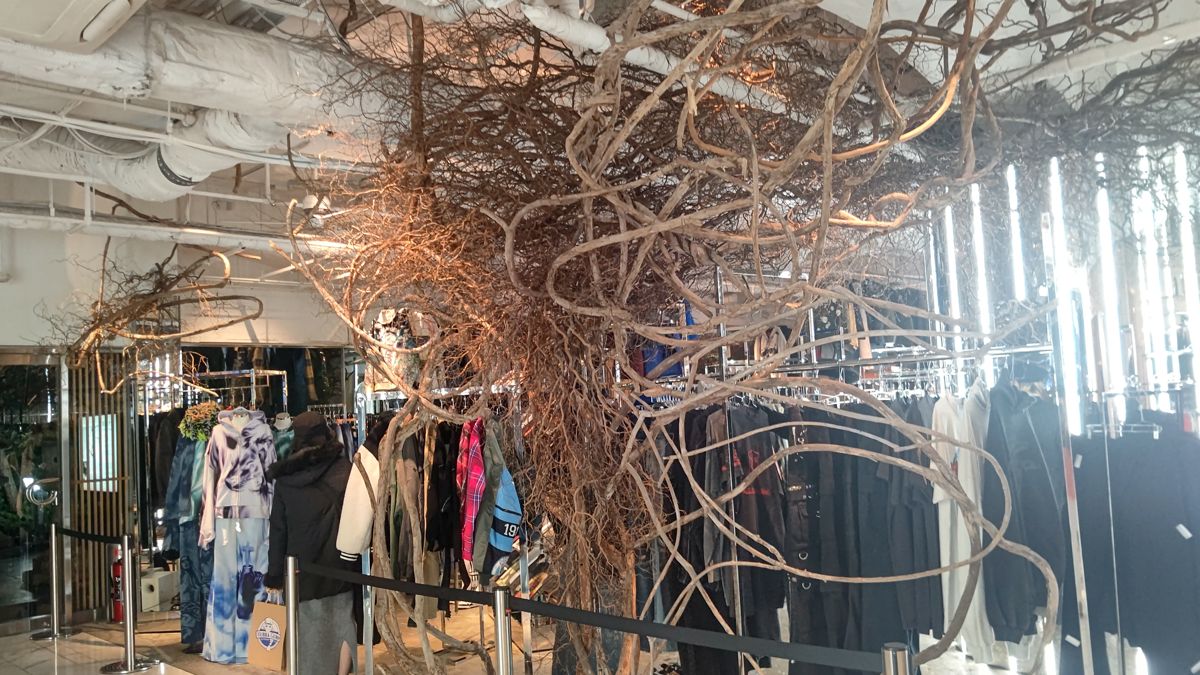
Even without making furniture, the shapes of branches and roots themselves can be put on show. In a clothing store in Shibuya, a huge tangle of dried branches and vines hung from the ceiling, spreading over the sales floor.
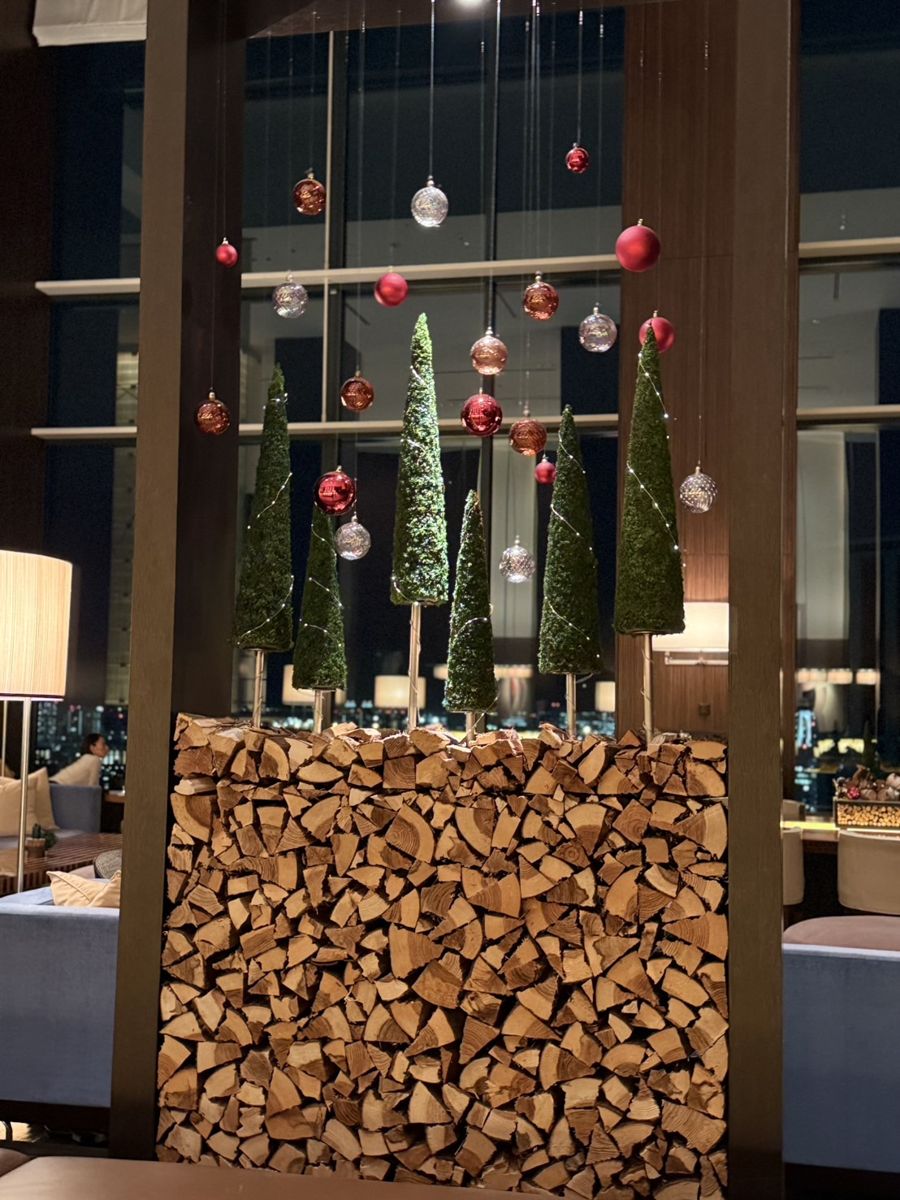
Split firewood, once stacked, becomes decoration in itself. In the lounge of the Conrad Tokyo in Shiodome, small conifer ornaments were lined up on a partition of firewood stacked like a wall.
The resin blocks and solid-wood stools were photographed on the sales floor of a department store in Tokyo with the store's permission. I did not record what kinds of wood and resin were used.
Los cimientos de la ciudad y el destino de los árboles cortados
Postes de madera
Los primeros postes de Japón se levantaron en 1869 para un telégrafo oficial entre la oficina del faro de Yokohama y el tribunal. Desde principios de Meiji hasta la era Taisho, los postes eran de madera.[5]
Los postes de madera se pudren por la línea del suelo. Un estudio de Hokkaido describe postes tratados a presión con creosota, sobre todo de pícea de Yezo y abeto de Sajalín, con alerce para los pequeños. Postes colocados en 1958 habían perdido el conservante 22 años después y estaban muy podridos, sobre todo a ras de suelo.[6] El informe, de 1981, señala que en zonas urbanas ya eran comunes los postes de hormigón.[6]
Cuándo y cómo se sustituyeron por hormigón los postes de madera de Tokio sigue en investigación. Las especies y el tratamiento citados son ejemplos de Hokkaido.
Ganar tierra a la bahía de Tokio
Gran parte del suelo de Tokio se creó rellenando el mar. Poco después de llegar a Edo, Tokugawa Ieyasu empezó a rellenar la ensenada de Hibiya, convertida en tierra entre 1593 y 1614. También rebajó la colina de Kanda y usó su tierra para rellenar desde Nihonbashi-Hamacho hasta Shinbashi. El centro del puerto de Edo se situó en Nihonbashi.[7]
Al este del río Sumida, los rellenos empezaron en 1596. Entre 1615 y 1629 la tierra ganada al mar creció rápidamente en el este del actual distrito de Chuo, incluida Reiganjima. Cada parcela, rodeada de canales, se convirtió en un kashi, un muelle para barcas.[7]
El almacenamiento de madera se solapa con esta historia de rellenos. El Kiba de la era Genroku lo construyeron los propios mayoristas rellenando las marismas de Fukagawa (capítulo 1). Shin-Kiba, adonde se trasladó en la era Showa, también está sobre terreno ganado a la bahía de Tokio.
El destino de la madera cortada
Tama es conocida desde antiguo como el «distrito forestal de Ome», productor sobre todo de pilares y rollizos para andamios.[8] Hoy, además de madera de construcción, se destina a tableros contrachapados (capítulo 7) y combustible. Aquí vemos por separado la madera cortada en la montaña y la cortada en la ciudad.
La madera de la montaña como combustible: Hinohara
La aldea de Hinohara sigue convirtiendo su propia madera en calor.[9][10]
| Año | Instalación | Detalles |
|---|---|---|
| 2012 | Centro termal Kazuma no Yu | Dos calderas de leña de 80 kW junto a calderas de queroseno; las unas 70 t de leña anuales proceden todas de la aldea[9] |
| 2012 | Producción de leña | Un sistema para recoger madera y hacer leña creó empleo a través del Centro de Recursos Humanos Silver; la leña se vende apilada en palés[10] |
| 2017 | Residencia Yasuragi no Sato | Una caldera de astillas sustituyó a los combustibles fósiles[10] |
La aldea subvenciona la tala y el arrastre para sacar la madera de aclareo que antes se dejaba en el monte.[10] Usar la madera como combustible da salida incluso a las partes delgadas y torcidas de los árboles.
Devolver los árboles de la ciudad a la ciudad: reciclaje verde
Las ramas y hojas de la poda de parques y calles también se aprovechan. Desde el año fiscal 1990, el distrito de Koto devuelve ramas y hojas a sus zonas verdes en lugar de quemarlas o enterrarlas.[11]
| Forma | Uso |
|---|---|
| Astillas | Amortiguación de senderos, acolchado de arriates[11] |
| Compost | Se reparte en actos del distrito; mejora del suelo en parques y escuelas[11] |
| Madera | Placas con nombres de árboles; material de manualidades para escuelas y guarderías[11] |
Tokio tiene más de un millón de árboles de calle (capítulo 8). Cómo aprovechar su poda es un desafío de «silvicultura urbana».
Laid on park paths: wooden paving of Tama timber
Tama wood is also used underfoot in metropolitan parks. According to a sign by the Tokyo Metropolitan Eastern Park Office that I saw in Ueno Park, the Tokyo government has used Tama timber, including thinnings, for road guard fences, the "Memorial Benches" in metropolitan parks and more, to conserve Tama's deteriorating forests and help prevent global warming. The sign explains that wooden paving will eventually rot and need replacing, but that this keeps thinnings in use and so helps protect the Tama forests.
It is a way of counting rot not as a defect but as a reason to keep using wood. The sign does not say, however, how much wood went into the paving, or whether Tama timber is used again each time it is replaced.
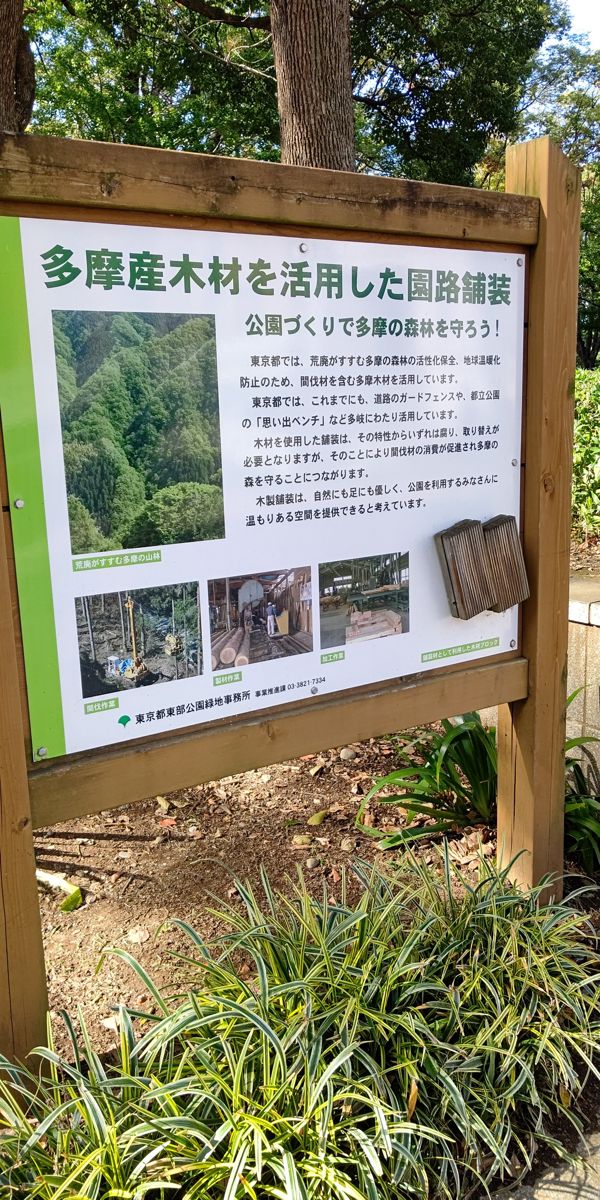
The sign's content is as of October 2021, when the photo was taken. I have not checked the current state of the paving.
Wood crossing the prefectural border: the Otsuki biomass power plant
Felled wood is sometimes carried out of Tokyo. The Otsuki Biomass Power Plant in Otsuki, Yamanashi, has an output of about 14,500 kW, enough electricity for about 30,000 households. It burns about 150,000 tonnes a year of chips made from unused thinnings and pruned branches, mainly from Yamanashi and the wider Kanto region.[12] It began commercial operation in summer 2018.[13]
When the author saw it from a train window in October 2020, logs were piled high in the plant's yard. They were "obstructing trees" (trees felled because they stand in the way of construction) from the building of the Shin-Tomei Expressway (the Second Tomei). Trees cut to build a road were being turned into electricity.
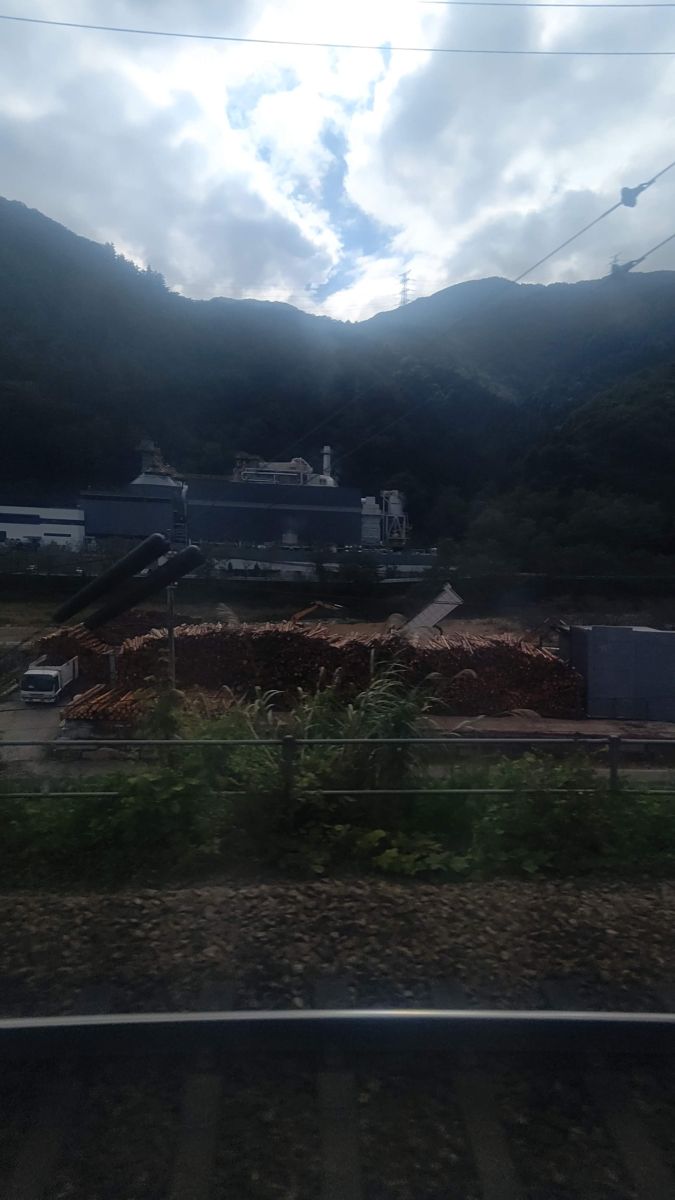
The acceptance of obstructing trees is based on what the author saw and heard on site; it has not been checked against materials from the power plant or the expressway company.
Fuentes
- 東京都 木育関連リーフレット(令和5年度) PDF
- コトバンク「大鋸」 Enlace
- 日本スポーツ振興センター「国立競技場について」 PDF
- 長野県林業総合センター 研究トピックス(接着重ね梁) PDF
- 国土交通省 無電柱化に関する資料 PDF
- 北海道立林産試験場『林産試月報』1981年4月号(クレオソート油処理木柱) PDF
- 国土交通省 関東地方整備局 東京港湾事務所「江戸の港」(原典:鈴木理生『江戸の川・東京の川』ほか) PDF
- 東京都「林業・木材産業循環成長対策 変更事業構想」 PDF
- 林野庁『平成28年度 森林・林業白書』事例(檜原村 数馬の湯) Enlace
- 環境情報センター(EIC)「首長に聞く」檜原村 Enlace
- 江東区「緑のリサイクル」 Enlace
- 大林組 ニュースリリース「大月バイオマス発電所の建設に着手」(2016年8月4日) Enlace
- 大林組 ニュースリリース(2018年6月1日、大月バイオマス発電所の営業運転開始) Enlace